




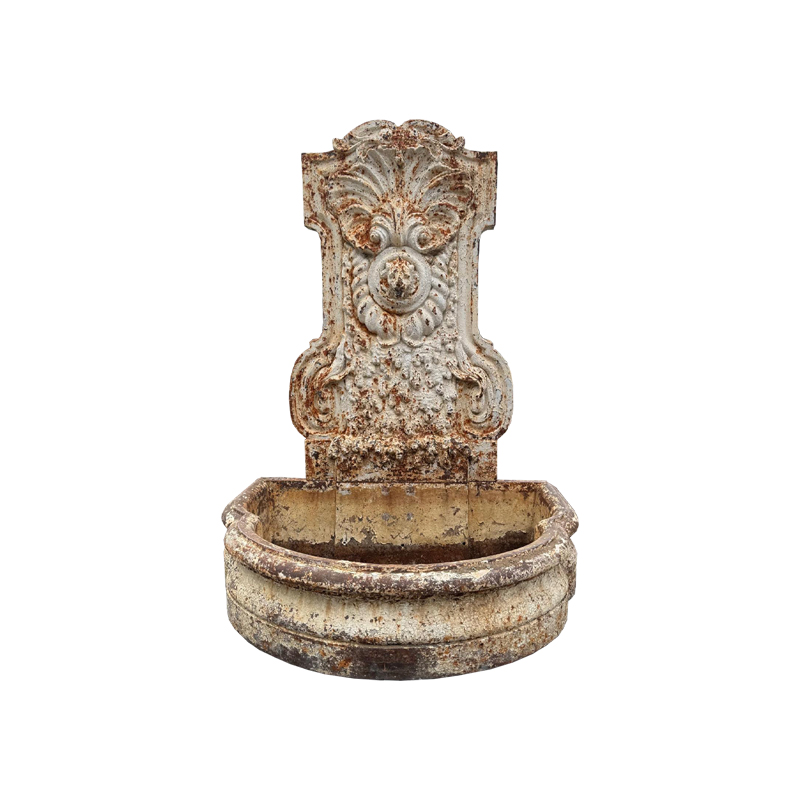
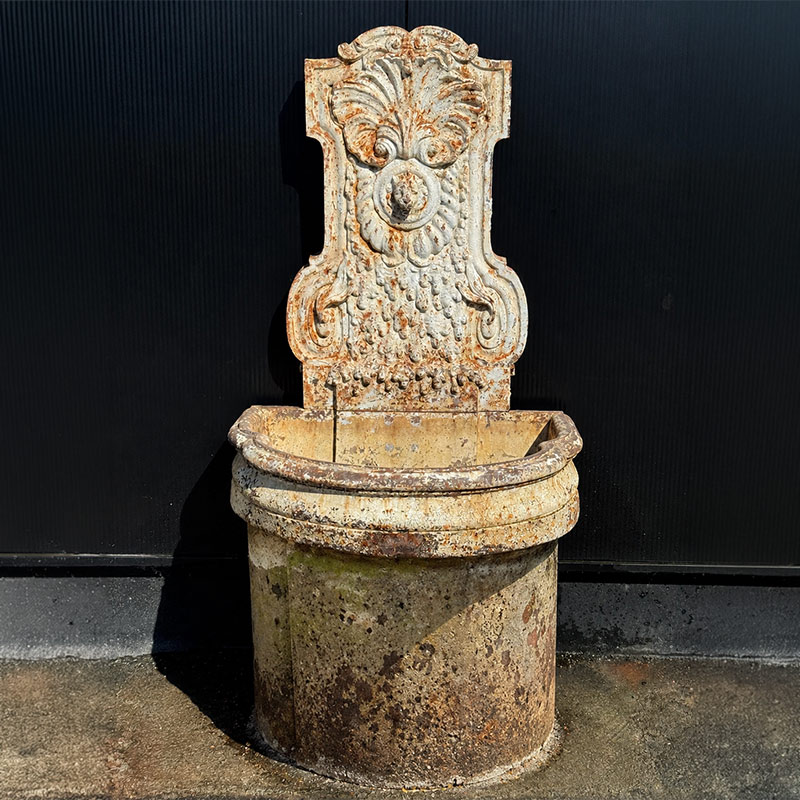
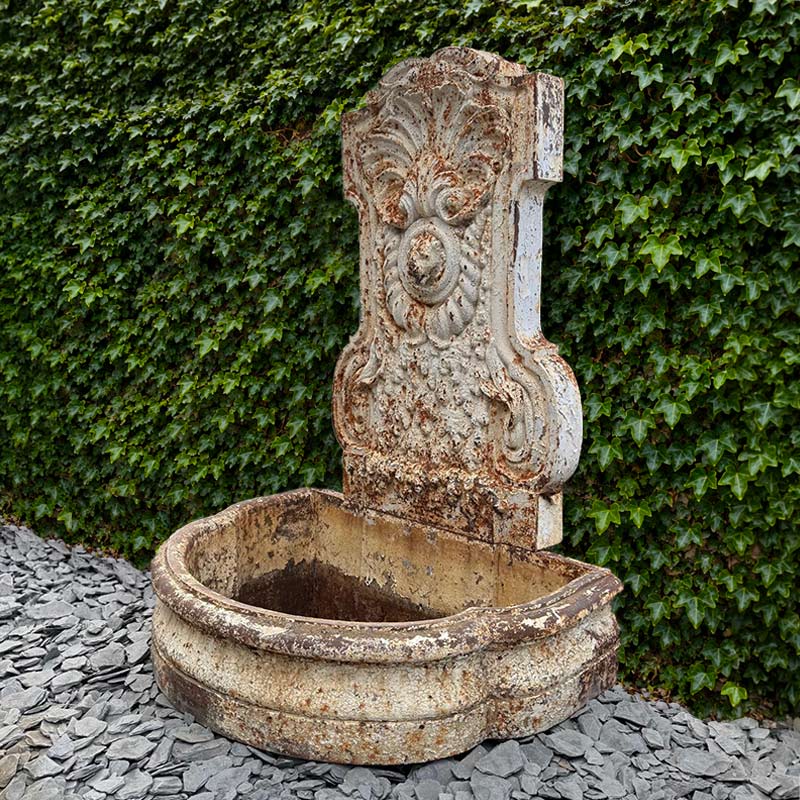
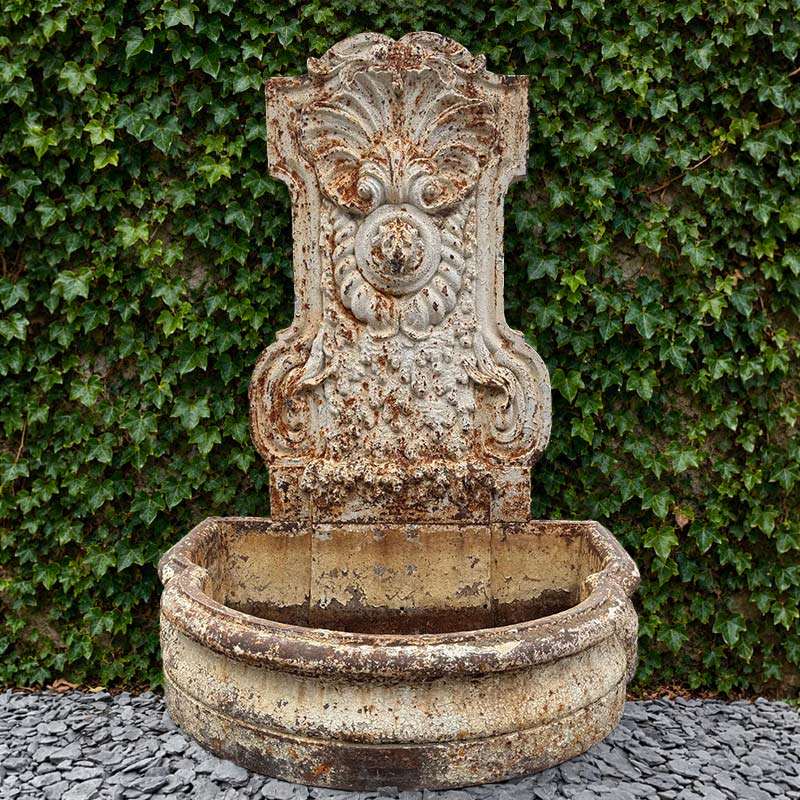
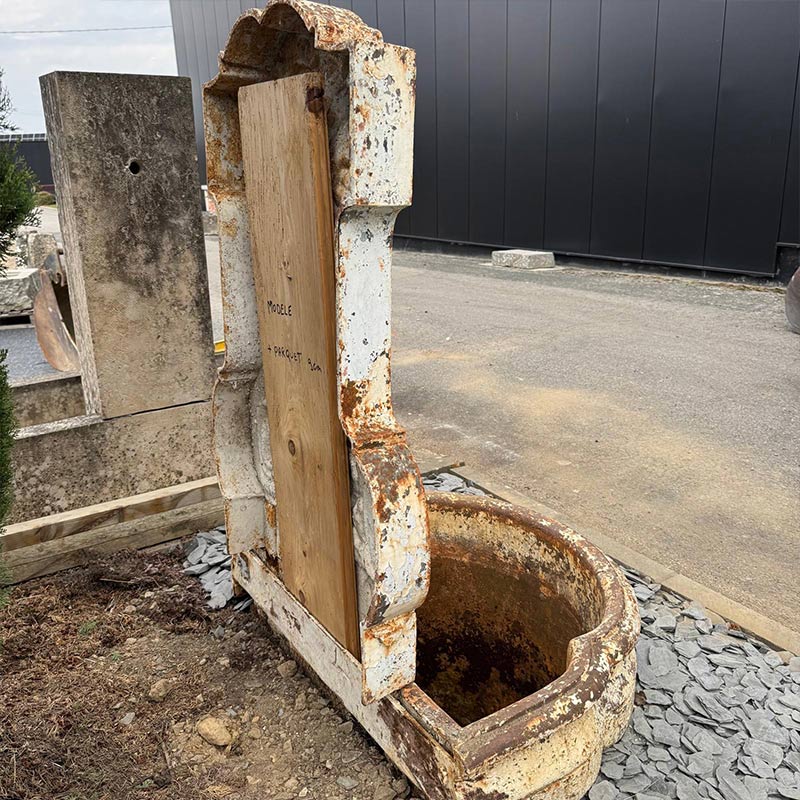
Ducel cast-iron wall fountain: This impressive late 19th-century cast-iron wall fountain was made by the renowned J.J. Ducel foundry, Maître de Forges in Paris. It stands out for the richness of its ornamentation, the quality of its cast ironwork, and its generously proportioned basin.
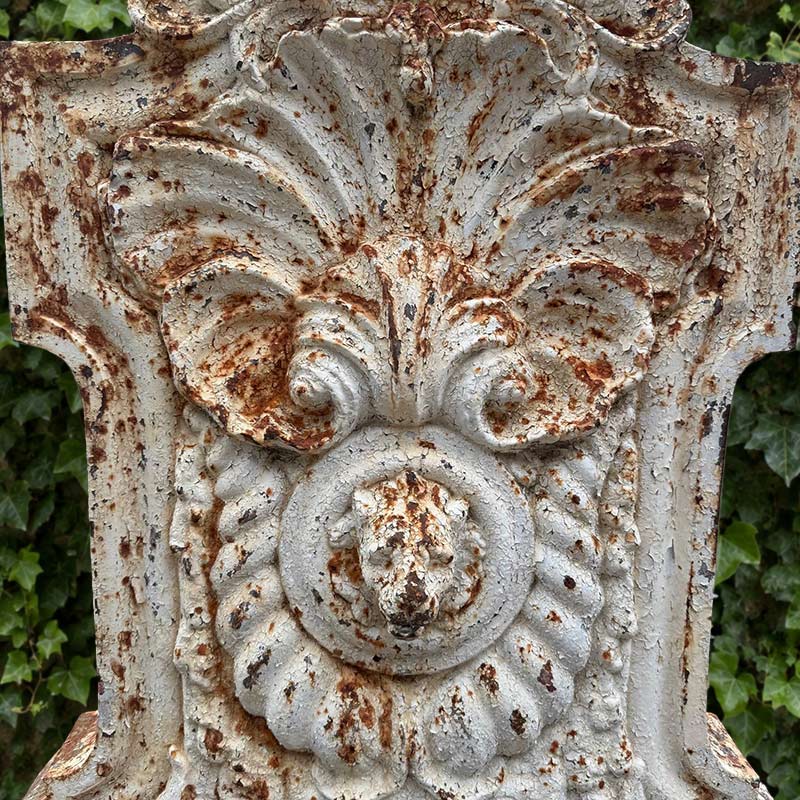
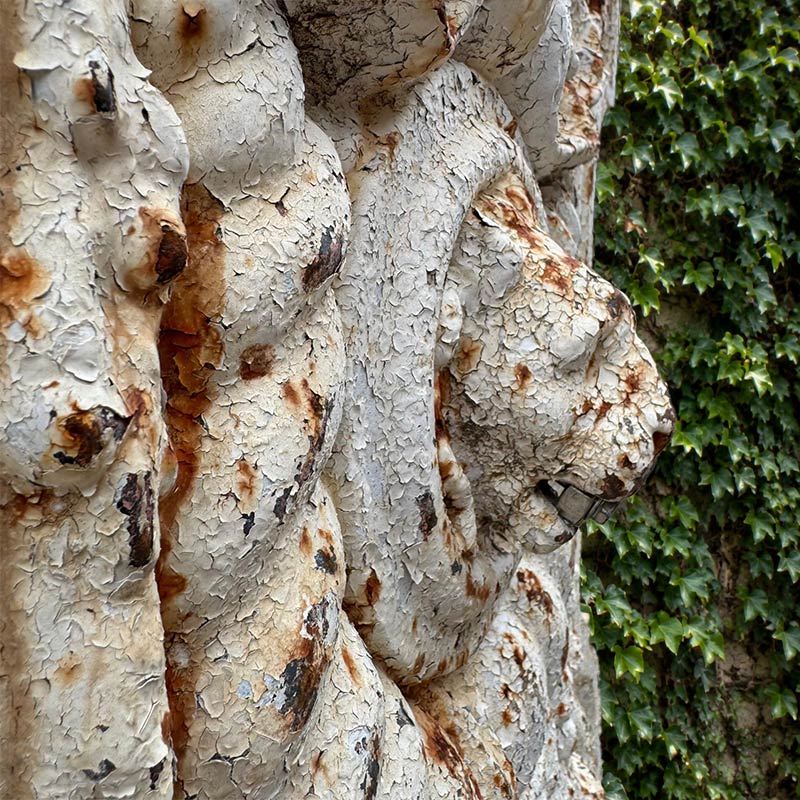
When in operation, a piping system allows water to flow directly from the lion’s mouth, creating the authentic effect of a working fountain and enhancing the dramatic presence of the piece.
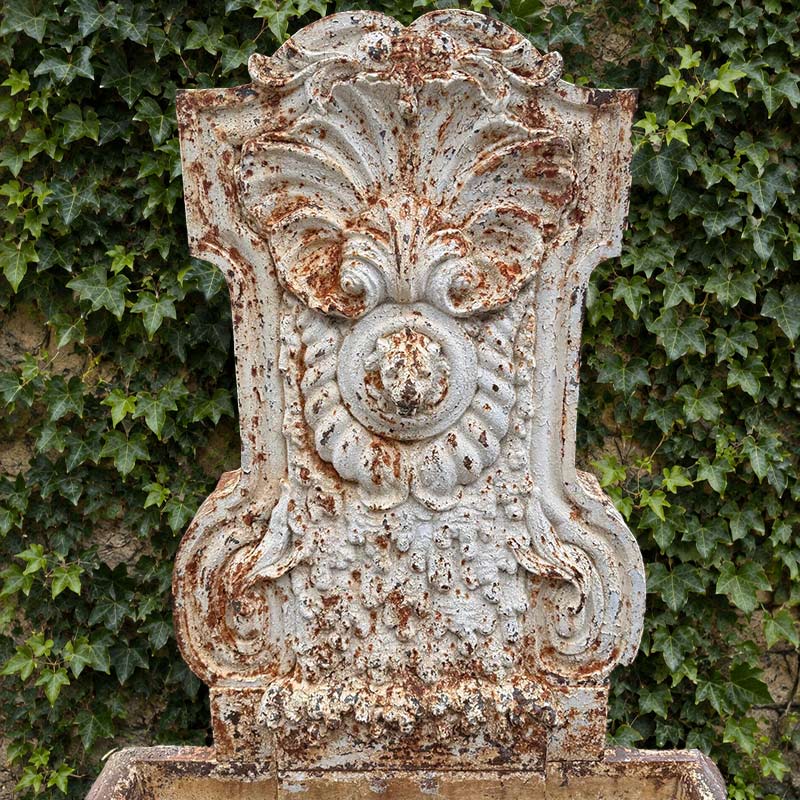
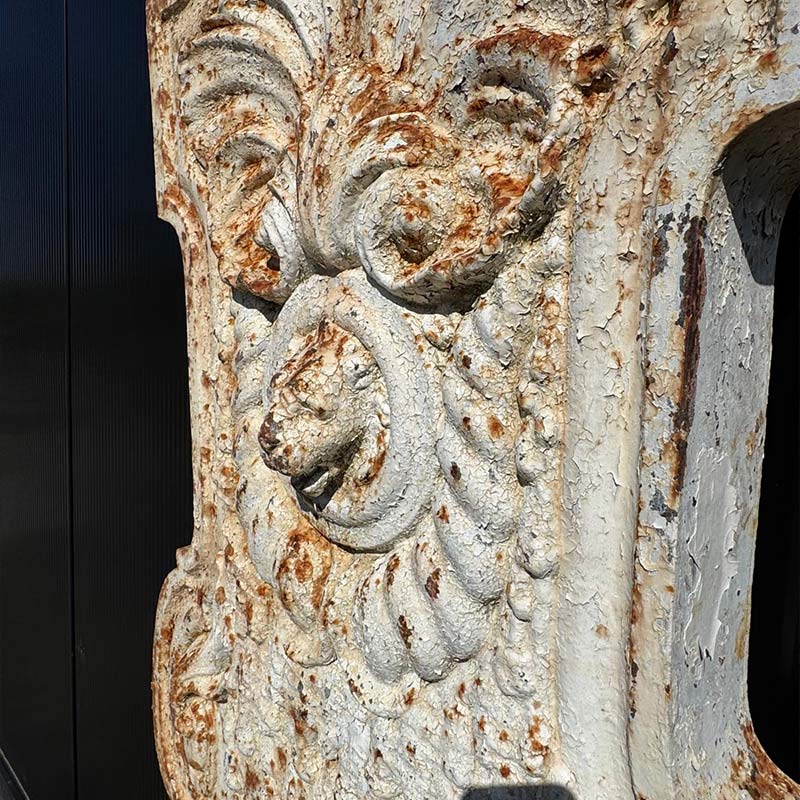
The backplate features an especially elaborate Neoclassical design. At the center, a high-relief lion’s head, surrounded by botanical motifs and scrollwork, is surmounted by a large shell forming the crowning element of the composition. Foliated ornaments, scrolls, and moulded details complete the design.
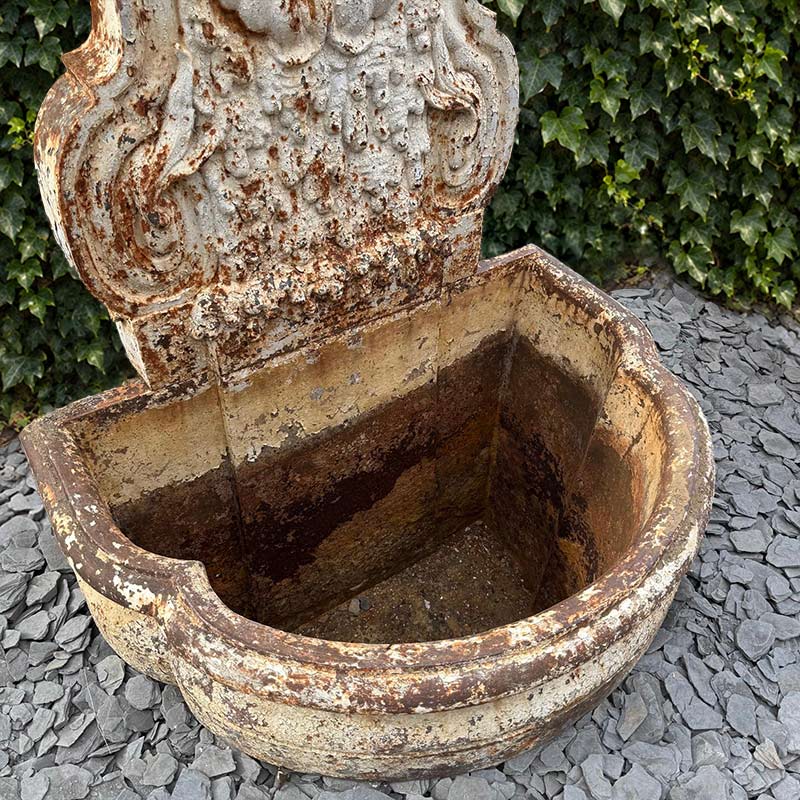
This antique fountain has acquired a beautiful aged patina, with variations in tone that bear witness to its age and exposure to the elements. Traces of oxidation, variations in color, and surface irregularities all contribute to its aged, authentic character. The decorative details remain clearly defined.
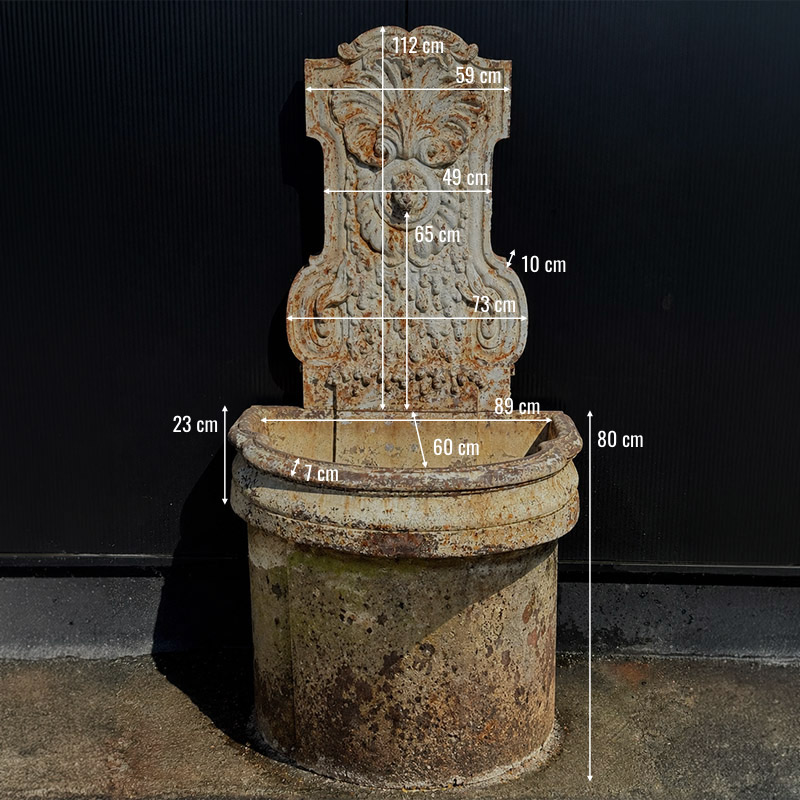
The rounded, moulded basin gives the piece its monumental presence. Its construction is particularly distinctive: the basin has a total depth of approximately 80 cm (31,5 inches) and is designed to be partially buried, leaving only a 23 cm (9 inches) rim visible above ground level.
The inscription “JJ Ducel, Me de Forges Paris”, visible on the basin, is an important element in identifying the piece. The Ducel foundry is particularly renowned for its production of decorative and architectural cast ironwork during the 19th century.
Jean-Jacques DUCEL, born on September 8, 1801, in Marseille, was a Maître de Forges based at 26 rue du Faubourg Poissonnière in Paris. He was a founder of copper, iron, and cast iron. He owned a foundry at Pocé-sur-Cisse in Touraine, which was one of France’s largest art foundries, until his death in 1877.
The company specialized in casting works of art and became one of the leading establishments of its kind in France, using both classical models by artists such as Coustou, Coysevox, and Le Hongre, and contemporary models by Lequesne, Pradier, and Duret. A sales showroom was opened in Paris, first at 22 rue des Quatre-Fils and later at 26 boulevard Poissonnière.
The castings were subsequently marked **J.J. DUCEL ET FILS A PARIS**. His son did not continue the business in which he had been associated with his father.
The Ducel foundry’s models were acquired by the Val d’Osne foundry in 1878.
Weight: 450 kg
Dimensions:
Available at our showroom in Segré (49), France.


